

What Is Tajweed and Why Is It Important?
What Is Tajweed and Why Is It Important?
Tajweed is the disciplined practice of giving Quranic letters their correct articulation, characteristics and recitation rights. It helps a learner read more accurately, protect words from avoidable distortion and recite with measured clarity—not merely with a beautiful voice.
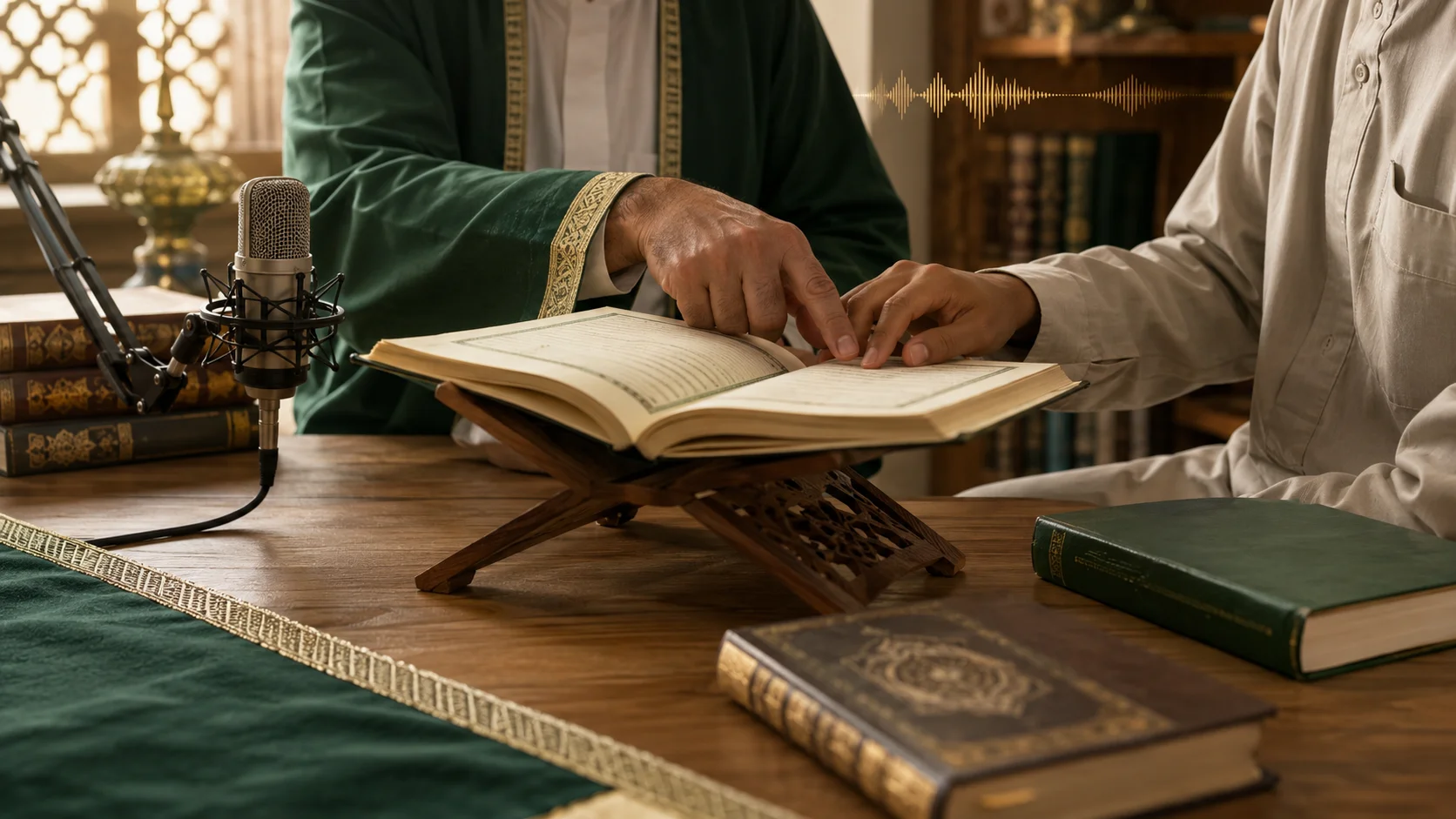
Tajweed Meaning: Excellence With Accuracy
Linguistically, Tajweed comes from an Arabic root associated with making something good or excellent. In Quran recitation, it means pronouncing every letter from its proper point of articulation and observing the qualities and contextual rules that belong to it.
In one sentence: Tajweed is the practical science of correct Quran pronunciation.
It covers Makharij (where letters emerge), Sifaat (their characteristics), elongation, nasalisation, heaviness and lightness, merging and clarity, as well as careful stopping and restarting. The goal is an accurate, natural recitation without affectation or unnecessary difficulty.
What Do Tajweed Rules Actually Cover?
Tajweed is learned as a connected skill. These foundations work together whenever a student reads a verse aloud.
Makharij al-Huruf
The correct articulation points of Arabic letters, including the throat, tongue, lips, nasal passage and oral cavity.
Sifaat al-Huruf
The qualities that distinguish letters which may emerge from nearby places, such as strength, softness, elevation and whispering.
Noon, Meem and Tanween
Rules such as Izhar, Idgham, Iqlab and Ikhfa, together with the practical performance of Ghunnah.
Madd and Measured Timing
Recognising the main categories of elongation and applying the appropriate count consistently while reciting.
Tafkhim and Tarqiq
Knowing when sounds are pronounced with heaviness or lightness so that words remain clear and balanced.
Waqf and Ibtida
Choosing suitable places to stop and restart without breaking the recitation in a way that confuses the intended meaning.
Tajweed, Tarteel and a Beautiful Voice
| Term | What it focuses on | What it does not mean by itself |
|---|---|---|
| Tajweed | Correct articulation, letter qualities and applicable Quran recitation rules. | It is not simply memorising technical terminology. |
| Tarteel | Measured, clear and deliberate recitation that allows letters and meanings to be observed. | It is not careless speed or artificial slowness. |
| Beautiful voice | Enhancing recitation naturally within correct pronunciation and respectful delivery. | A pleasing melody cannot replace correct letters or Tajweed. |
For a fuller comparison, read: Difference Between Tajweed and Tarteel.
Measured Quran Recitation in the Quran and Sunnah
The sources emphasise deliberate recitation, careful delivery and learning the Quran properly.
Recite in a measured manner
Allah commands measured recitation in Surah al-Muzzammil 73:4. Read the verse and translation.
The Prophet’s measured recitation
Anas ibn Malik described the Prophet’s recitation as prolonged in its proper places. Verified hadith explanation.
Verse-by-verse clarity
Umm Salamah described a recitation in which the Prophet paused verse by verse. Verified hadith explanation.
والأخذُ بالتجويدِ حتمٌ لازمُ
من لم يُجوِّدِ القرآنَ آثمُ
لأنه به الإلهُ أنزلا
وهكذا منه إلينا وصلا
These famous lines from Ibn al-Jazari’s Al-Muqaddimah express the seriousness of preserving Quranic recitation as it was transmitted. In the following lines, he describes Tajweed as the adornment of recitation and as giving letters their due rights and qualities—with gentle pronunciation, without forced performance.
Is Learning Tajweed Obligatory?
Correct reading comes first
A Muslim should learn to pronounce Quranic words correctly and avoid clear mistakes that change letters or meanings. This practical foundation matters more than collecting terminology without being able to apply it.
Detailed mastery is a higher level
Scholars distinguish between avoiding evident recitation errors and mastering every theoretical detail or fine performance feature. Not every minor imperfection should be turned into an automatic judgement on the reader.
What Tajweed Is—and What It Is Not
Tajweed should lead to clearer Quran recitation and greater confidence. It should not become a collection of labels separated from actual reading.
- It is correct pronunciation, not musical performance.
- It is guided practice, not theory alone.
- It is gradual improvement, not demanding perfection before progress.
- It is attentive recitation, not excessive affectation or strain.
- It supports memorisation, because the learner stores a more accurate sound pattern from the beginning.
How to Learn Tajweed Step by Step
The strongest path combines listening, seeing the written text, reciting aloud and receiving correction from a qualified teacher.
Check your Arabic reading foundation
If letters, vowel marks or joined words are still difficult, begin with a structured reading foundation such as the Noorani Qaida course.
Let a teacher assess your recitation
A live assessment reveals recurring Makharij, Sifaat, Madd and stopping mistakes that a learner may not hear independently.
Correct the most important errors first
Begin with letter substitutions, unclear articulation and mistakes that may distort words; then refine recurring rules gradually.
Learn one rule, then find it in the Mushaf
Understanding becomes useful when the student can recognise the rule inside verses rather than only repeat its definition.
Recite, receive correction and repeat
The mouth needs practice. Read to a teacher, listen to the correction, repeat the word and apply the same principle when it appears again.
Use trusted recordings as support
Listening to careful reciters helps reinforce accurate sound, but recordings and apps cannot fully replace individual feedback.
Review recorded mistakes regularly
Keep a short list of recurring errors and revisit them during later lessons until the correct form becomes natural and consistent.
Should Every Verse Be Perfect Before Moving On?
No learner should be left with errors that clearly alter letters or words. At the same time, demanding complete mastery of every fine detail before allowing any progress can make beginners feel that Tajweed is an obstacle.
Correct major errors immediately
The teacher gives priority to clear pronunciation and errors that affect the form or meaning of a word.
Improve recurring rules progressively
Because Tajweed principles repeat throughout the Quran, the student continues reading while the teacher reinforces each rule across later verses.
The balanced goal is accurate progress: neither careless speed nor exhausting perfectionism. See also the scholarly guidance on Tajweed during Quran memorisation.
Learning Tajweed With Quranic Values
Quranic Values teaches Tajweed through live, personalised Quran recitation rather than recorded lessons alone. The student reads directly to a teacher, receives focused correction and applies the rule again within the Quran.
Our teachers’ backgrounds include Quran study and teaching experience in Madinah. The academy is independent and does not claim official endorsement by Al-Masjid an-Nabawi.
How the learning process works
- A complimentary 3-day trial and recitation assessment
- A personalised starting point based on the student’s level
- Theoretical explanation connected to immediate practice
- Direct correction of Makharij, Sifaat and recurring rules
- Lesson records and visual learning resources for review
- Structured live learning for children and adults
Tajweed Questions for Beginners
Can I learn Tajweed if I cannot read Arabic well?
Yes, but the reading foundation should come first. A learner who struggles to recognise or join Arabic letters may progress more confidently by starting with Noorani Qaida and introducing simple Tajweed application gradually.
Can Tajweed be learned online?
Yes. A live online lesson allows the teacher to hear the student, demonstrate pronunciation and correct mistakes in real time. Reliable audio and consistent attendance are important.
Is listening to reciters enough to learn Tajweed?
Listening is valuable for building an accurate sound model, but it may not reveal your own mistakes. Direct recitation to a qualified teacher provides the feedback that recordings cannot.
Do children and adults learn Tajweed differently?
The foundations are the same, but lesson length, explanation and workload should match age, reading ability and attention. Children often benefit from visual repetition, while adults may prefer concise rules connected immediately to practice.
Can I memorise Quran while learning Tajweed?
Yes. Beginning memorisation with accurate pronunciation helps prevent deeply rooted mistakes. Major errors should be corrected promptly, while finer application can continue improving through repeated teacher-guided practice.
How long does it take to learn Tajweed?
There is no single guaranteed duration. Progress depends on the starting level, attendance, practice, language background and the depth of study. A clear assessment is more useful than a fixed promise.
Build Your Tajweed Knowledge
Selected References
- Quran 73:4 — measured recitation
- Ibn al-Jazari — Al-Muqaddimah, Chapter of Tajweed
- King Fahd Quran Complex — Al-Tajweed Al-Muyassar
- Al-Tajweed Al-Muyassar — bibliographic record
- “The best of you are those who learn the Quran and teach it” — hadith verification
- The proficient Quran reciter — hadith verification
Let a Qualified Teacher Listen to Your Recitation
Start with a complimentary 3-day trial, receive a level assessment and learn which Quran pronunciation and Tajweed areas deserve priority in your personal plan.

Sheikh Abdul Rahman Yaqoob is a certified Quran & Tajweed scholar, holding a Bachelor’s Degree with Honors in Noble Quran and Islamic Studies from the Islamic University of Madinah. He is the Lead Instructor at Quranic Values, dedicated to bridging the gap for Muslim families in the West by providing authentic Islamic education and nurturing a generation connected to their faith and identity